In 1942, British regulations imposed limits on the number of buttons and meters of fabric allowed per garment. Despite these constraints, some creations escape the norm thanks to clever assembly tricks or clandestine sourcing.
Parisian fashion houses continue to produce, sometimes in secret, bold pieces that influence global style. The adjustments forced by the war do not prevent the emergence of unprecedented silhouettes or the rise of figures who become iconic.
When fashion must adapt: the influence of World War II on 1940s dresses
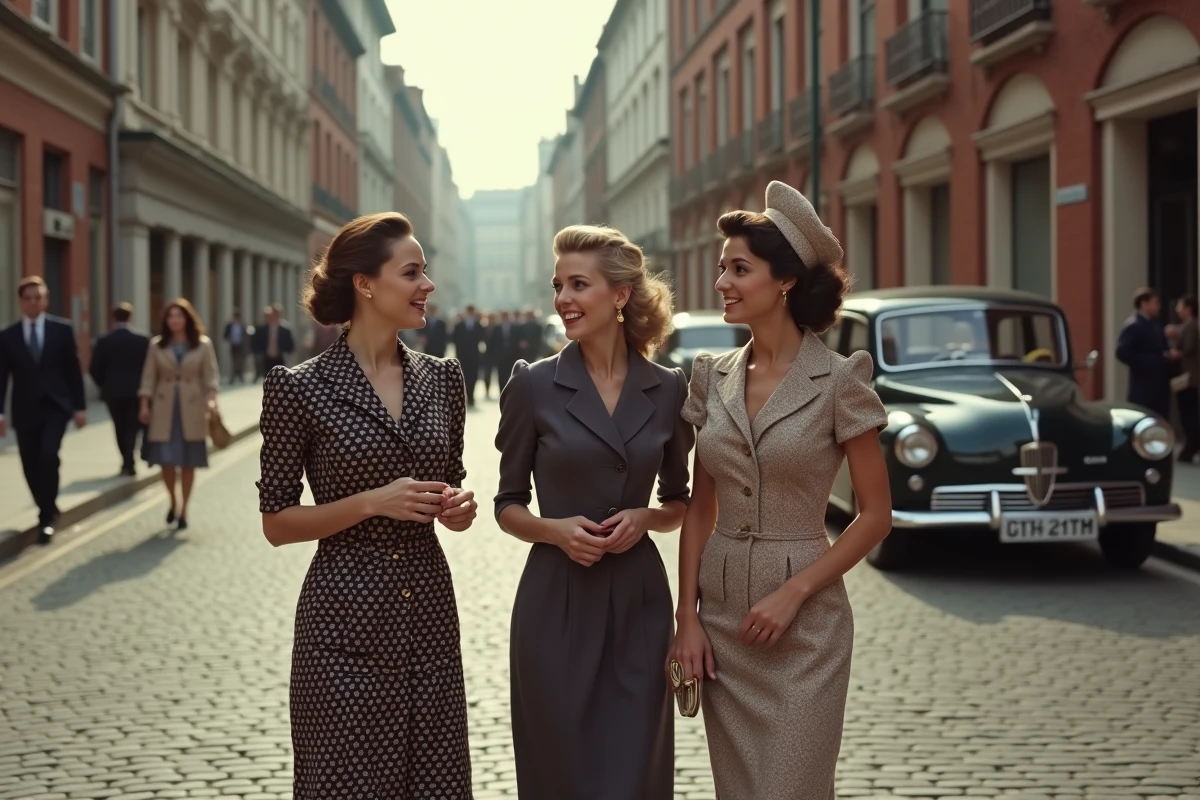
The shock of World War II disrupts the benchmarks of women’s fashion in the 1940s. Paris, once the undisputed beacon of creativity, suddenly finds itself cut off from the world. Restrictions abound: fabric coupons are counted, raw materials are monopolized by the war effort, buttons and embellishments are rationed to the extreme. On paper, fashion should fade away. In reality, it invents new codes. Dresses become sober, structured, with sharp lines and defined shoulders. A belt accentuates the waist, every centimeter of fabric is calculated, but femininity does not disappear.
Faced with the imposed uniformity, women double their inventiveness and transform constraint into strength. Double-breasted jackets become commonplace, skirts shorten to save material, and pockets assert themselves as functional details. Colors, most often neutral, sometimes give way to discreet whimsy: fine embroidery, an unexpected lapel, a contrasting collar. Some houses, led by Chanel, keep the flame of elegance intact while juggling the imperatives of rationing.
Across the Atlantic, these evolutions cross oceans. In the United States, the “Utility look” becomes prevalent on the streets. The 1940s dress, far from being just a symbol of deprivation, becomes the banner of a new identity. The era combines resilience, inventiveness, and a taste for detail, telling a shared story where beauty finds a way against all odds. To delve deeper into this exploration, discover Blogueur net to grasp the multiple facets of vintage fashion and the mythical dresses of the 1940s, revealing how the global context shaped the aesthetics and style of an entire generation.
Bold silhouettes and unforgettable patterns: what makes the vintage dresses of this decade so iconic
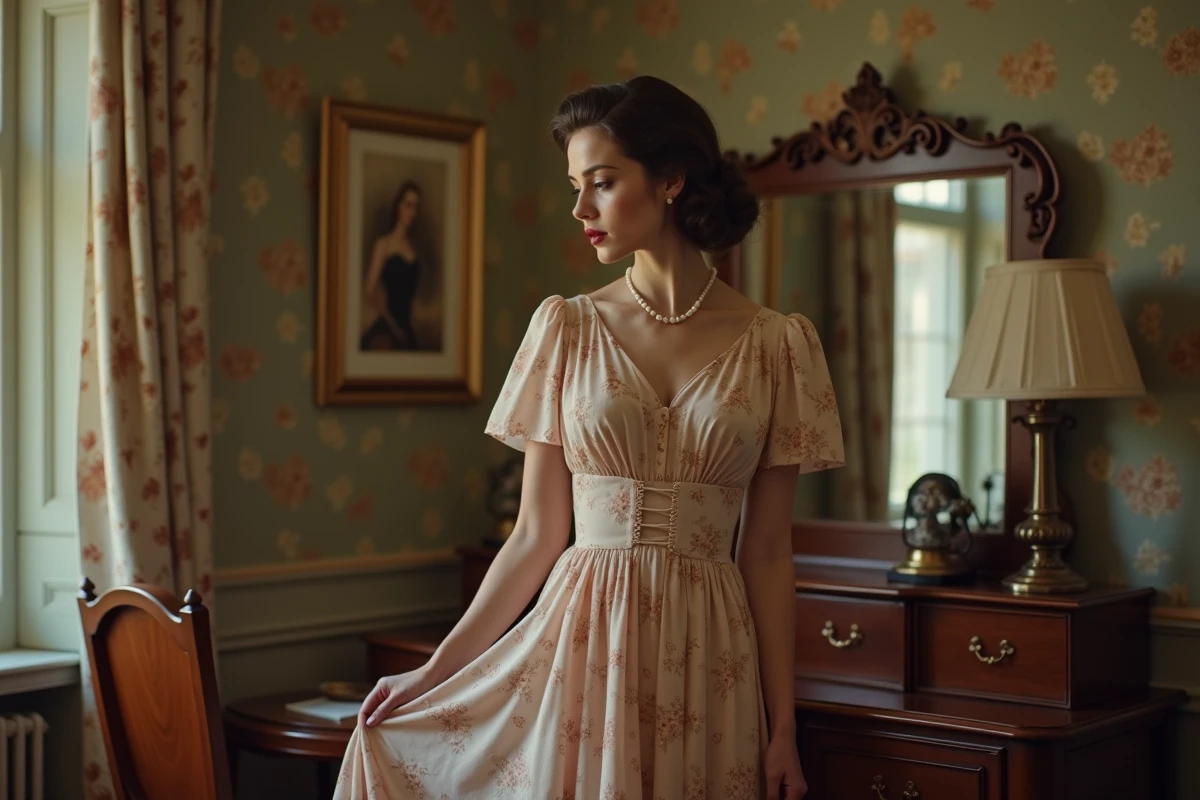
The vintage dress of the 1940s does not merely dress; it asserts a strong positioning. It reflects a modern aesthetic while playing with the limits imposed by its era. The cinched waists, achieved with fitted belts, create structured silhouettes and highlight femininity. The skirts, often straight or slightly flared, stop at the knee, inaugurating a way of standing and moving that is anything but trivial.
Here are the elements that mark the uniqueness of these dresses in the history of clothing:
- The rise of the pin-up style with graphic patterns, polka dots, stripes, and stylized flowers, which brighten a wardrobe constrained by sobriety
- The mid-length skirt, straight or barely flared, emblematic of the retro look of the decade
- Accessories: short gloves, rigid bags, wooden-soled shoes, which complete each silhouette
By the end of the 1940s, the influence of Christian Dior is felt. Curves become rounder, the waist is further cinched, and skirts gain volume. This prelude to the “New Look” marks a break from the austerity imposed by the war. The vintage fashion of this era acts as a laboratory where every detail, from the lapel to the sleeve cut, bears witness to a desire for expression and a resolutely forward-looking perspective.
Pin-ups, Hollywood stars, and inspirations to explore to extend the journey into 1940s fashion
The imprint left by pin-ups on the popular culture of the 1940s is indelible. Alberto Vargas and Gil Elvgren immortalize on glossy paper the image of a bold, sometimes irreverent femininity. Their creations cross the Atlantic and feed the inspiration of designers and seamstresses alike. These models, displayed in homes or slipped into magazines, democratize the pin-up dress: fitted waist, full skirt, polka dots or stripes, sometimes adorned with a simple bow on the chest.
In Hollywood, the vintage dress becomes the signature of the greatest actresses. Rita Hayworth imposes the slit skirt, Marilyn Monroe makes the form-fitting dress her own, while Bettie Page challenges the conventions of glamour with her unique presence. Beyond the screens, iconic photographs from Getty Images testify to the elegance displayed at California soirées. The influence of these stars does not stop there: their style nourishes the streets, inspires designers, and shapes the collective imagination.
For those eager to continue this immersion, nothing beats delving into the photographic archives and outfits of Jane Birkin or Brigitte Bardot. Their way of reinterpreting the legacy of the 1940s, between studied simplicity and touches of boldness, demonstrates how the vintage dress transcends generations. Exploring the fashion of this decade is to navigate between icons, creators, and small details that make all the difference. The dress becomes a manifesto, revealing the power of a garment capable of telling far more than just a fleeting trend.