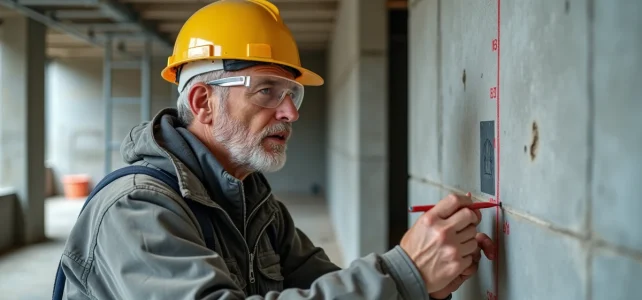
When you want to combine a kitchen and a living room separated by a 20 cm concrete block wall, the first difficulty is not technical: it is to put together a solid enough file so that the project is not rejected even before the first blow of the hammer. Refusals in the homeowners’ association meetings are multiplying for openings deemed too large or poorly documented.
Technical file for the general assembly: what really blocks projects
In a co-ownership, a vote in the general assembly is mandatory before any intervention on a load-bearing wall. Feedback from structural engineers and renovation groups shows a clear trend: an incomplete file is now the leading cause of refusals in the general assembly. Co-owners and property managers demand more than just a simple request letter.
See also : How to Manage Parental Rejection in Adulthood: Compassionate Tips and Solutions
Specifically, today we expect a file almost equivalent to that of a small rehabilitation project. To know how to make an opening in a load-bearing wall according to the rules, one must gather plans, calculation notes, and proof of insurance even before contacting a company.
- Dimensioned plans showing the exact location of the opening, the width of the lintel or the I-beam, and the lateral supports
- Calculation note specifying the load transfers and the sizing of the reinforcement (metal profile, reinforced concrete)
- Phasing schedule: order of installation of the props, cutting sequence, drying time of the sealing mortar
- Ten-year insurance certificate from the company carrying out the work
Presenting this level of detail reassures co-owners about the stability of the building. Omitting the calculation note or the phasing is almost a guarantee of a negative vote.
Recommended read : Practical Tips to Save Time When Applying for a Passport

Progressive opening of the load-bearing wall: the method that limits cracks
On the ground, practice has evolved. Rather than cutting the entire width of the wall in one go, more and more craftsmen and engineers prefer a multi-phase opening. First, an intermediate “window” is created in the wall, a first reinforcement element is installed, and then the opening is gradually enlarged to the final size.
This approach reduces the sudden stresses transmitted to the floors and partitions of the upper levels. Job site feedback is clear: fewer cracks in the ceilings, fewer creaks in the days following the intervention.
Propping and reinforcement: two inseparable operations
Propping is not a formality. Props are positioned on either side of the future opening, ensuring they rest on points capable of bearing the load (concrete slab, distribution footing on wooden floor). Removing the props before the sealing mortar has fully set is the most common mistake on poorly supervised job sites.
The reinforcement generally takes the form of an I-beam (metal I-beam) or a reinforced concrete lintel. The choice depends on the span of the opening, the type of wall (concrete block, brick, stone), and the loads above. An old stone wall behaves differently from a hollow concrete block wall: the supports must be wider, and the leveling mortar must be suitable for the existing masonry.
Structural study and calculation of the I-beam: why one cannot improvise
The sizing of the metal profile or lintel is based on a load transfer calculation. This calculation takes into account the weight of the floors, the roof, the partitions located above, and sometimes operational loads (furniture, storage). An undersized I-beam can deflect by several millimeters, which is enough to cause cracks throughout the building.
The structural engineering office produces a calculation note that specifies the section of the profile, the support length on each side (generally, it does not go below 20 cm on common masonry), and the type of sealing. This document engages the engineer’s responsibility and is an essential piece for the ten-year insurance.
Feedback varies on this point, but some craftsmen carry out the sizing themselves when they have the required skills and insurance. In any case, a site visit is necessary to assess feasibility and identify the constraints of the wall.

Concrete process of the load-bearing wall opening project
Once the study is validated and the permits obtained (preliminary declaration at the town hall, vote in the general assembly if co-ownership), the project follows a precise sequence.
We start with the protection of the floors and remaining furniture, then neutralize the electrical and plumbing networks that cross the wall. This verification avoids unpleasant surprises once the cutting begins.
Typical work sequence
- Installation of props and distribution footings, checking their plumb and allowable load
- Partial cutting of the wall (phase 1), installation of the I-beam or lintel, sealing with mortar
- Waiting for the mortar to set before any further cutting
- Progressive enlargement of the opening to the final dimension (phase 2, or even phase 3 for large spans)
- Demolition of remaining parts, removal of debris, site cleaning
- Finishing touches: covering the profile (drywall, plaster), resuming floor and ceiling connections
Each cutting phase is followed by a visual inspection of the upper floors to detect any micro-cracks. If signs of movement appear, work stops and reinforcement is applied before continuing.
Cost and quotes: the variables that affect the bill
The cost of an opening in a load-bearing wall depends on the type of wall (stone, brick, concrete block), the width of the opening, the accessibility of the site, and the number of floors above. A serious quote includes the structural study, the supply and installation of the reinforcement, demolition, debris removal, and finishing work. Requesting several detailed quotes remains the most reliable way to compare, provided that each quote includes the calculation note and the ten-year certificate.
The opening of a load-bearing wall remains a project where the preparation of the file is as crucial to success as the quality of the cutting. A complete file facilitates the vote in the general assembly, secures the insurance, and allows the craftsman to work within a clear framework. It is better to spend two more weeks on the study phase than to deal with cracks for two years.