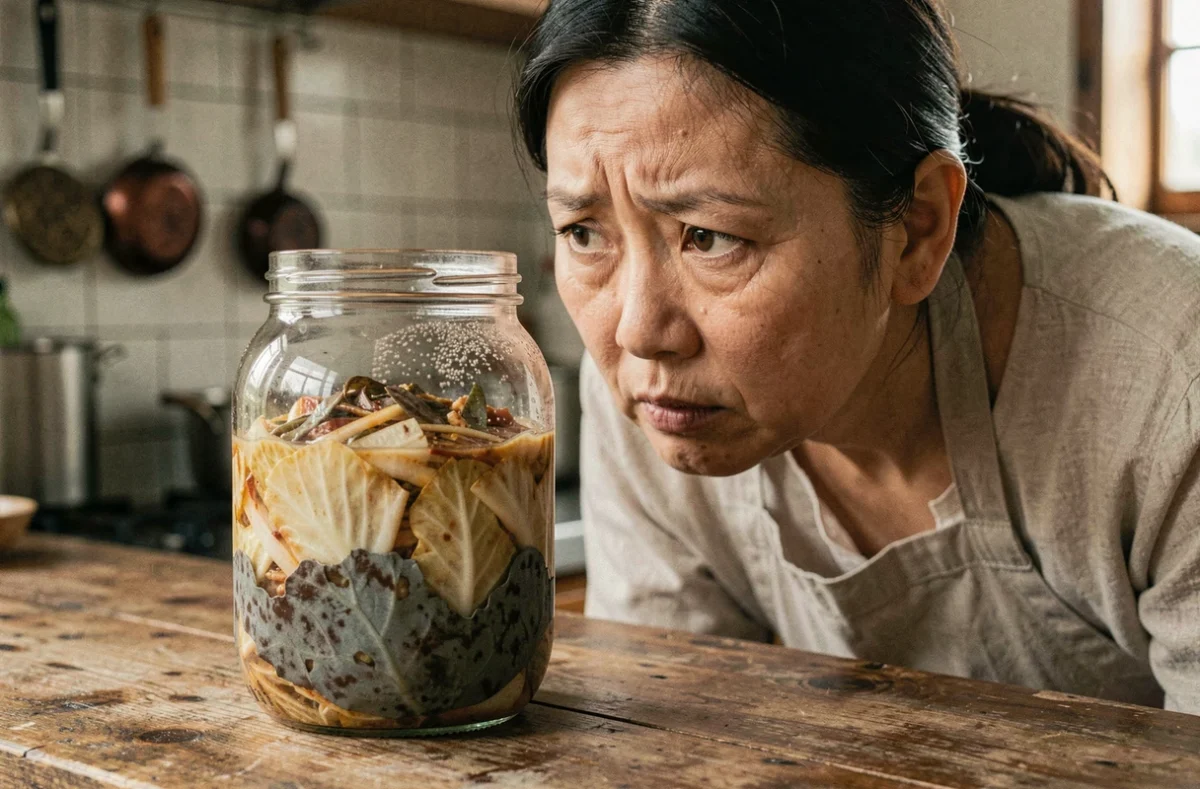
An forgotten jar of kimchi at the back of the refrigerator always raises the same question: normal fermentation or actual spoilage? The line between the two is not as clear-cut as one might wish. Kimchi, by nature, is a living food whose acidity, smell, and texture are constantly evolving. Distinguishing an expected change from a sign of spoilage requires knowing what to observe and in what order.
White film, colored spots: what the surface of kimchi reveals
The first instinct when faced with suspicious kimchi is visual. Any anomaly on the surface deserves attention, but not all mean the same thing.
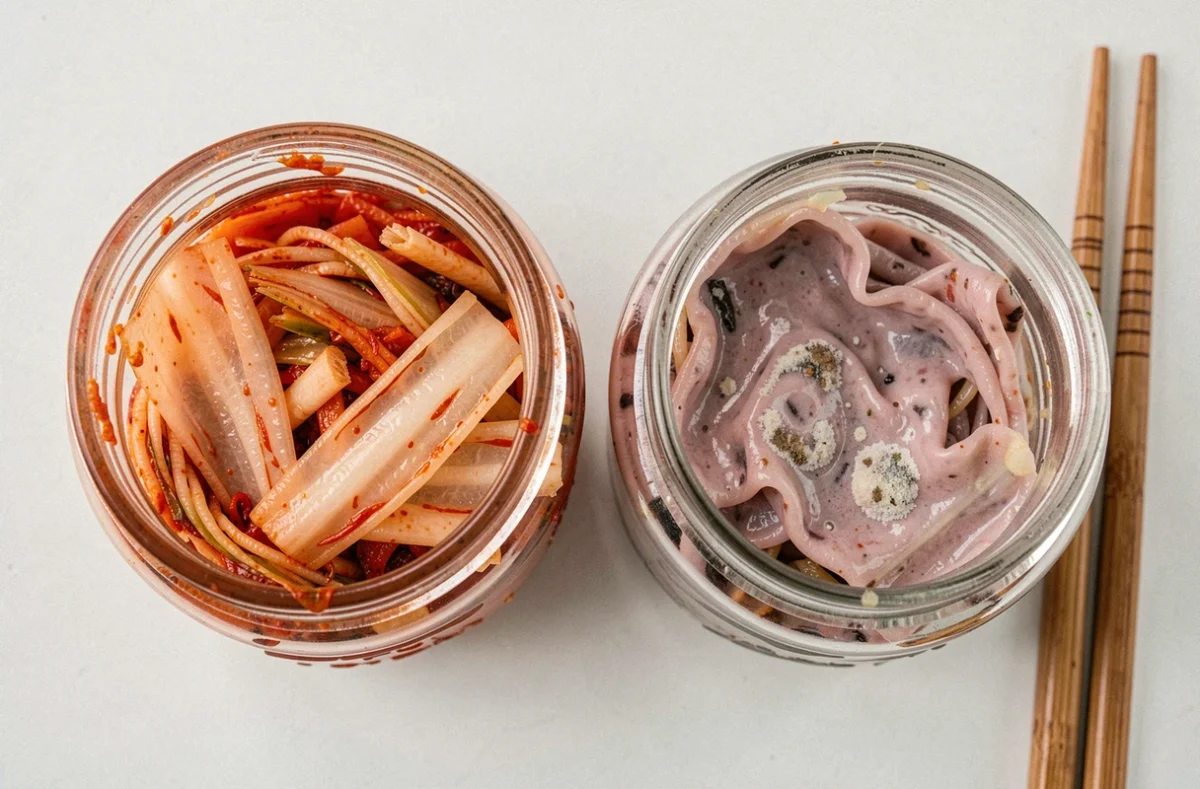
The World Institute of Kimchi, cited by AsiaE in September 2026, distinguishes golmaji, a smooth white film formed by yeasts, from colored molds. The golmaji can be removed, and the kimchi underneath remains edible. However, green, blue, or black spots warrant discarding the entire jar.
The problem is that reliable identification with the naked eye remains difficult. A slightly fuzzy white film could be either harmless yeast or the beginning of mold. The article from AsiaE recommends caution with any mold that is not clearly identified.
To recognize if the kimchi has gone bad, color remains the most discriminating criterion: healthy kimchi turns orange over the course of fermentation, while pronounced browning or grayish hues signal advanced oxidation or contamination.
Comparison table: normal fermentation and signs of kimchi spoilage
| Criterion | Normal Fermentation | Probable Spoilage |
|---|---|---|
| Smell | Sour, tangy, vinegary | Putrid, rancid, reminiscent of ammonia |
| Surface | Smooth white film (golmaji) | Green, blue, or black spots |
| Color of Vegetables | Orange, deep red | Marked browning, grayish reflections |
| Texture | Crunchy to slightly softened | Viscous, slimy to the touch |
| Taste | Sharp, tangy | Bitter, soapy, chemical aftertaste |
| Liquid (brine) | Cloudy, slightly effervescent | Thick opaque, foul odor |
This table allows for cross-referencing multiple indicators. A single isolated criterion (a slightly strong smell, for example) is not always enough to conclude. The combination of two or more signals in the “spoilage” column should lead to discarding the kimchi.
Mycotoxins and cooking: why scraping off mold is not enough
A common reflex is to remove the moldy part and consume the rest, or even to cook the kimchi to “kill” the bacteria. This approach poses a serious problem.
According to Health Chosun (September 2026), some molds produce mycotoxins that are heat-resistant. Cutting away the visible area guarantees nothing: fungal filaments (mycelium) spread beneath the surface well beyond the apparent spot. Mycotoxins, in turn, diffuse into the brine and permeate the surrounding vegetables.
The reported recommendation is straightforward: discard the entire affected batch. No selective sorting, no salvaging cooking. This point distinguishes kimchi from hard cheese, where mold remains on the surface of a dense medium. In a liquid and porous environment like kimchi brine, contamination is three-dimensional.
Refrigeration: cold slows down but does not protect
The idea that well-refrigerated kimchi is safe from mold is partially false. AsiaE (September 2026) specifies that kimchi in the refrigerator can develop mold despite the cold. Refrigeration slows fungal growth; it does not stop it.
Several factors accelerate spoilage even in the cold:
- The brine level drops below the vegetables, exposing them to air and promoting oxidation and then contamination
- Repeated opening of the jar introduces fresh oxygen and external microorganisms with each handling
- A poorly sealed jar or a non-airtight lid continuously lets air in, partially negating the anaerobic effect of lactic fermentation
The most effective action remains ensuring that the vegetables stay submerged in the liquid. Pressing down the contents after each opening and using a fermentation weight limits exposure to air.
Smell and taste: signals that acidity alone does not summarize
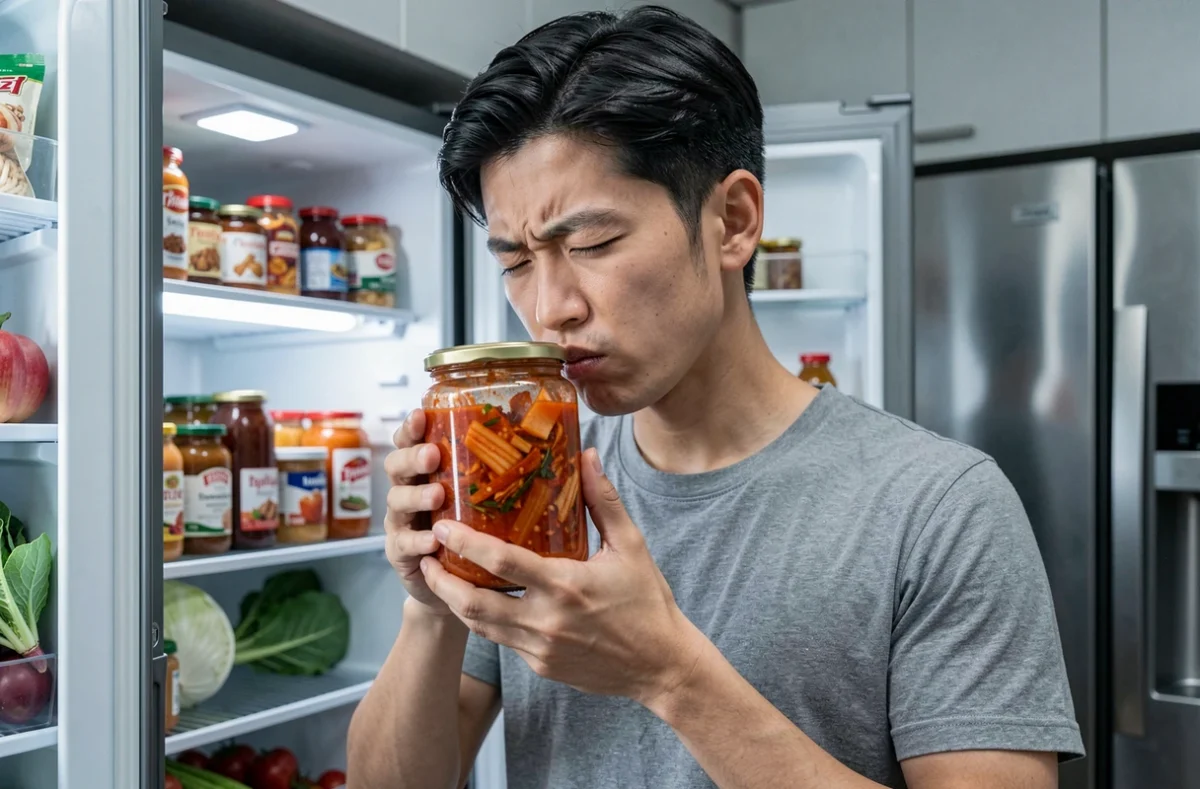
Mature kimchi has a strong smell. The acidic odor, sometimes vinegary, even slightly sulfurous, is part of normal lactic fermentation. What should raise alarms is a qualitative change, not a quantitative one.
An ammonia or strong rot smell indicates protein decomposition, typical of contamination by undesirable bacteria. This smell is very different from the usual sharp acidity: it evokes organic waste more than a fermented condiment.
In the mouth, spoiled kimchi presents an unusual bitterness or soapy taste. The normal acidity of kimchi is sharp and clear. A “flat” acidity, accompanied by a chemical or metallic aftertaste, signals a microbial imbalance. In this case, spitting out and discarding the batch remains the only reasonable option.
Texture provides a final clue: kimchi whose cabbage pieces have become viscous or slimy to the touch has surpassed the stage of over-fermentation. The viscosity comes from the breakdown of cell walls by bacterial enzymes that are no longer those of the desired lactic fermentation.
Identifying spoiled kimchi relies on cross-referencing multiple indicators rather than a single signal. Surface, smell, taste, texture, and state of the brine form a bundle. In case of doubt about any of them, the cost of a discarded jar is always less than the risk of food poisoning.