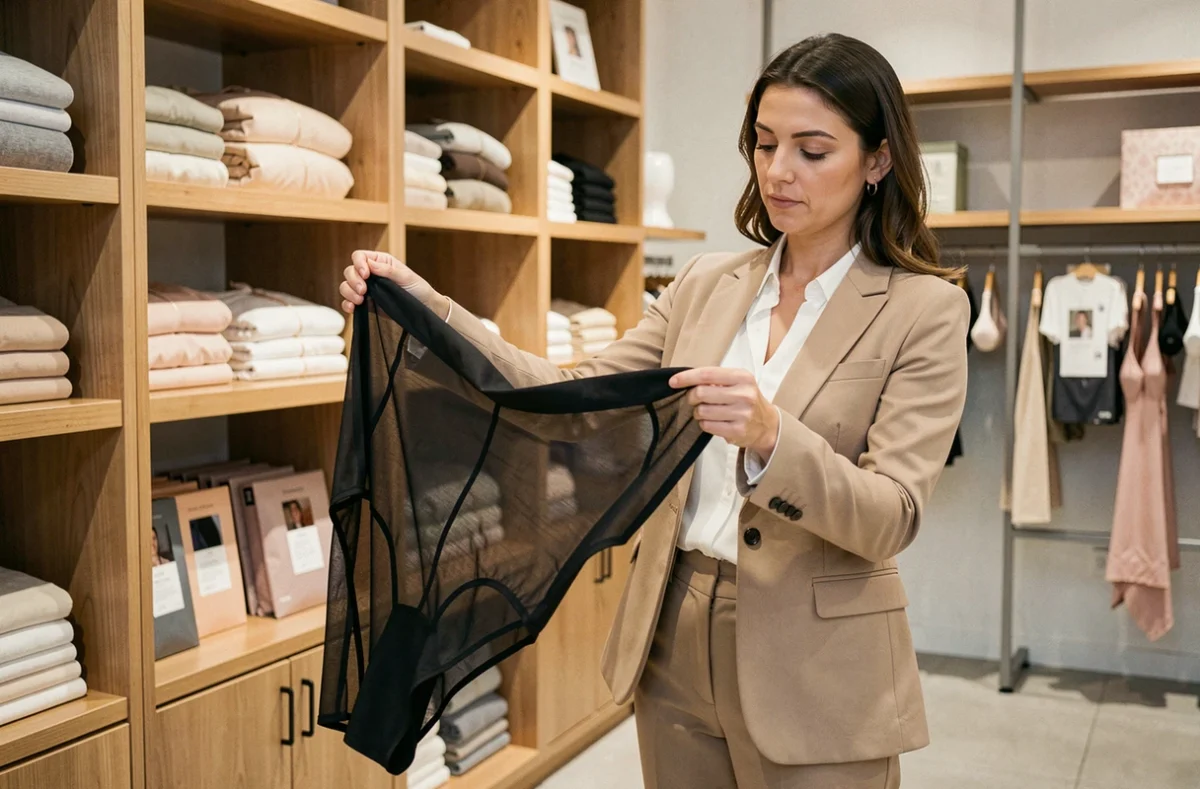
The tights market has long been reduced to a choice between low prices and opacity. In recent years, French regulations have changed the information available at the time of purchase: manufacturing origin, detailed composition, environmental impact. These elements change the way tights are evaluated even before putting them on.
Textile Regulation and Tights: What the Label Really Says
Decree No. 2025-957 and the order of September 6, 2025, require manufacturers to display more precise environmental information on textiles containing more than 50% synthetic fibers. For tights, this now includes the potential release of plastic microfibers during washing.
Displaying the composition alone (polyamide, elastane, cotton) is no longer sufficient to compare two products. The countries of weaving, dyeing, and manufacturing can be indicated separately, allowing one to distinguish tights entirely made in France from those made in Europe from yarn dyed in Asia.
In practice, this transparency remains uneven across brands. Some online stores detail every step of production, while others stick to the legal minimum. To delve deeper into this topic, the Vog Store experience on Chez Agathe illustrates how a brand can structure its offering around perceived and verifiable quality.
Denier, Materials, and Actual Durability of Tights
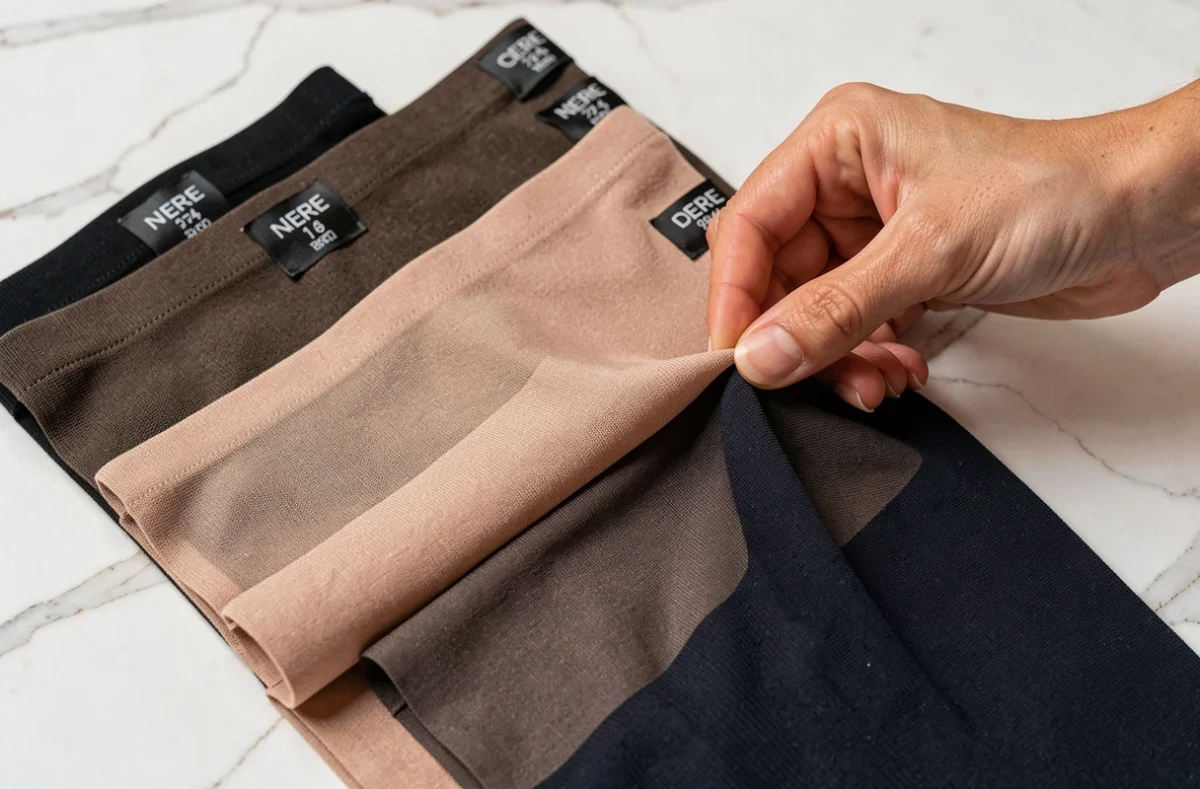
Denier measures the weight in grams of a thread of 9,000 meters. The higher the number, the more opaque and durable the tights are. Very fine tights, under 15 deniers, remain the most fragile and often run after a few uses.
Understanding Denier Thresholds
Tights between 20 and 40 deniers offer a compromise between transparency and durability. Beyond 40 deniers, they fall into the semi-opaque and opaque categories, suitable for low temperatures and more resistant to mechanical wear.
A high denier does not guarantee longevity on its own. The construction of the knit matters just as much: a snag-free or reinforced knit at the toes and waistband extends the product’s lifespan much more than a simple increase in denier.
Natural or Synthetic Fibers
- Polyamide (nylon) remains the base of most tights. It provides elasticity and fineness but generates microfibers during washing.
- Elastane (Lycra) ensures support and recovery to the original shape. Its proportion generally varies between 10 and 20% of the total weight.
- Cotton and wool appear in thick winter tights. They improve thermal comfort but reduce elasticity and fineness of the finish.
- Microfiber, softer to the touch, is found in mid-range and high-end lines, with a matte finish appreciated for formal wear.
Field reports diverge on the comparative durability of natural and synthetic fibers in fine tights. A mixed cotton tight resists snags better but loses its shape more quickly than a model primarily made of polyamide.
Size and Fit: The Most Underestimated Criterion
A tight that is too small experiences excessive tension, accelerating the appearance of pulled threads. A tight that is too large slips, bunches at the ankle, and creates unsightly folds at the knee. The wrong size remains the primary cause of rapid degradation.
Size guides vary from one brand to another. Two tights labeled “size 3” from two different manufacturers can show significant differences at the waistband or in leg length. Taking measurements (hip circumference, inseam height) before ordering online limits unpleasant surprises.
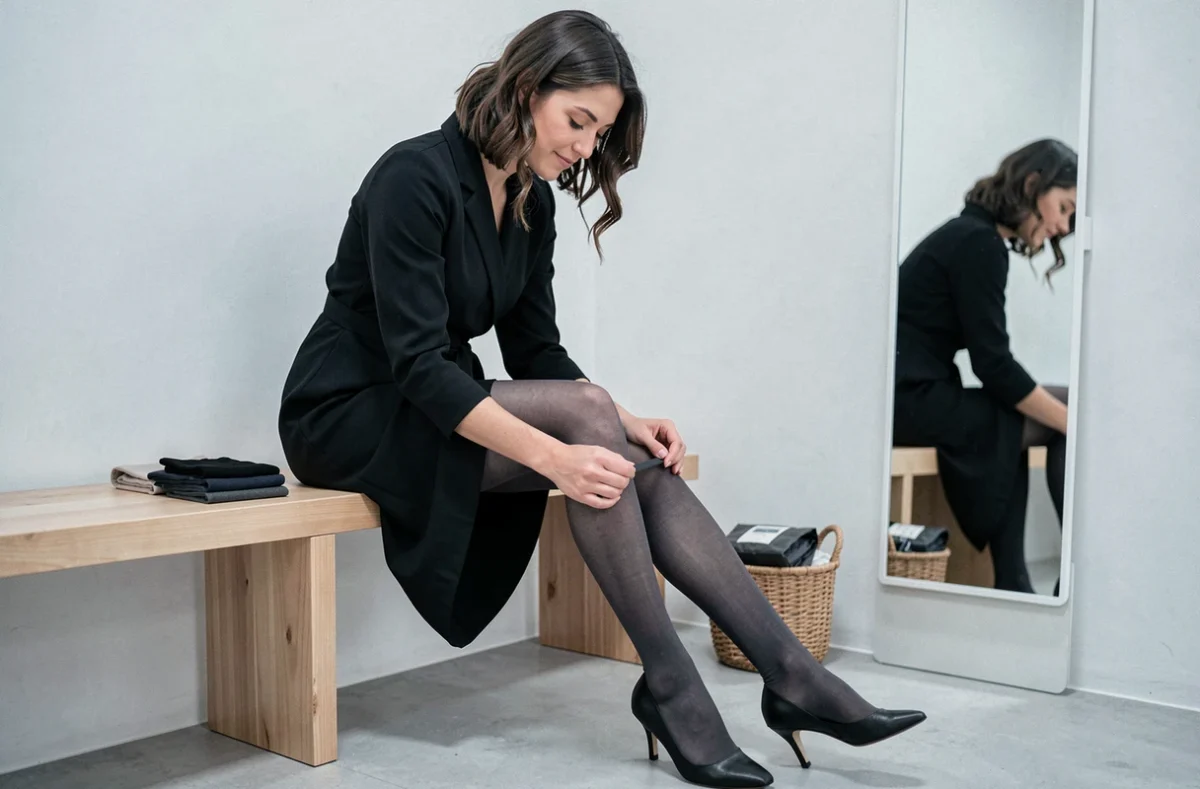
Some signs of a good fit: the waistband does not roll, the tights do not pull at the knee, and the fabric hugs the ankle without forming a pocket. If any of these points are problematic, the size or cut is not suitable, regardless of the product’s price.
Textile Repair Bonus and Tights: A Still Limited Option
The textile repair bonus, established under the AGEC law, allows for a direct deduction of part of the repair cost at a certified professional. The scheme covers interventions generally ranging between 6 and 25 euros depending on the type of repair.
For very fine tights, the practical interest remains limited. A 15 denier run at the calf is not easily repaired, even by an experienced seamstress. In contrast, opaque tights with reinforced seams or thick wool models can benefit from a repair (elastic waistband, inseam stitching).
The pertinent question before purchase is therefore not only the unit price but the actual repairability of the model: sufficiently dense knit to be resewn, accessible seams, fabric that does not unravel around the repair point.
In-Store or Online Purchase: What Changes for Choosing Tights
In-store, the feel of the product through the packaging gives a first indication of the knit density and fiber softness. Direct comparison between two references of the same brand remains more intuitive than on a screen.
Online shopping, on the other hand, offers broader access to manufacturing information, customer reviews, and detailed technical sheets. Consumers can compare exact compositions, production countries, and feedback from other buyers on actual longevity.
- Check the return policy before ordering, especially for underwear and tights (some brands refuse returns after opening).
- Consult reviews mentioning size: feedback on fit is more reliable than overall ratings.
- Prefer product sheets that detail the denier, complete composition, and manufacturing origin.
The choice between in-store and online shopping mainly depends on one’s knowledge of their own body shape. A person who knows their size in a given brand will shop online without risk. Someone who hesitates between two sizes will save time by trying in-store.
The quality of a tight is verified in use, rarely by the label alone. Cross-referencing information on composition, origin, and knit construction provides a more reliable picture than price or brand name.